
Mathematical achievement cannot always be measured by examination grades. A test might indicate the number of questions they answered correctly but not necessarily how confident they are in their approach to unfamiliar problems, how well they understand mathematical concepts, or whether they can use a formula without assistance. Real academic improvement takes place when students make a number of minor gains that build on their existing skills.
This is especially relevant when studying for GCSE Maths where students will learn new topics, question types and skills of varying difficulty. Students can find online mathematics tutors who can provide them with regular guidance, practice specific skills and understand their learning patterns. At SkillBridge Tutors, the idea of progress is not a number on a report card, but a process.
Look Beyond Examination Results to Understand Learning
Test scores give insightful information but they are just one aspect of a student's educational experience. A student could get a comparable mark in two tests, but might make a lot of progress in their problem-solving skill, their accuracy in their calculations, or their knowledge of mathematical reasoning.
A structured tutoring programme takes into account a number of indicators, such as:
- Conceptual understanding: Can the student explain why a mathematical method works, instead of memorising it?
- Problem-solving ability: Can they recognize the right way to solve a problem if it is presented in a different manner?
- Calculation accuracy: Do they make fewer mistakes with numbers, number sense and numerical operations, and algebra?
- Time management: Are they able to write questions within a reasonable time and not rush?
- Independent learning: Are they able to try out difficult questions without asking for help?
- Consistency: Do they use the concepts they have learned in the correct way in different exercises?
How Tutors Identify Strengths and Learning Gaps
All students learn mathematics in their own way. Some will learn algebra easily and not know geometry, others may know calculations but not word problems. These differences are identified to enable tutors to plan lessons for individual requirements.
There are a number of ways an online gcse maths tutor can determine the level of learning of a student:
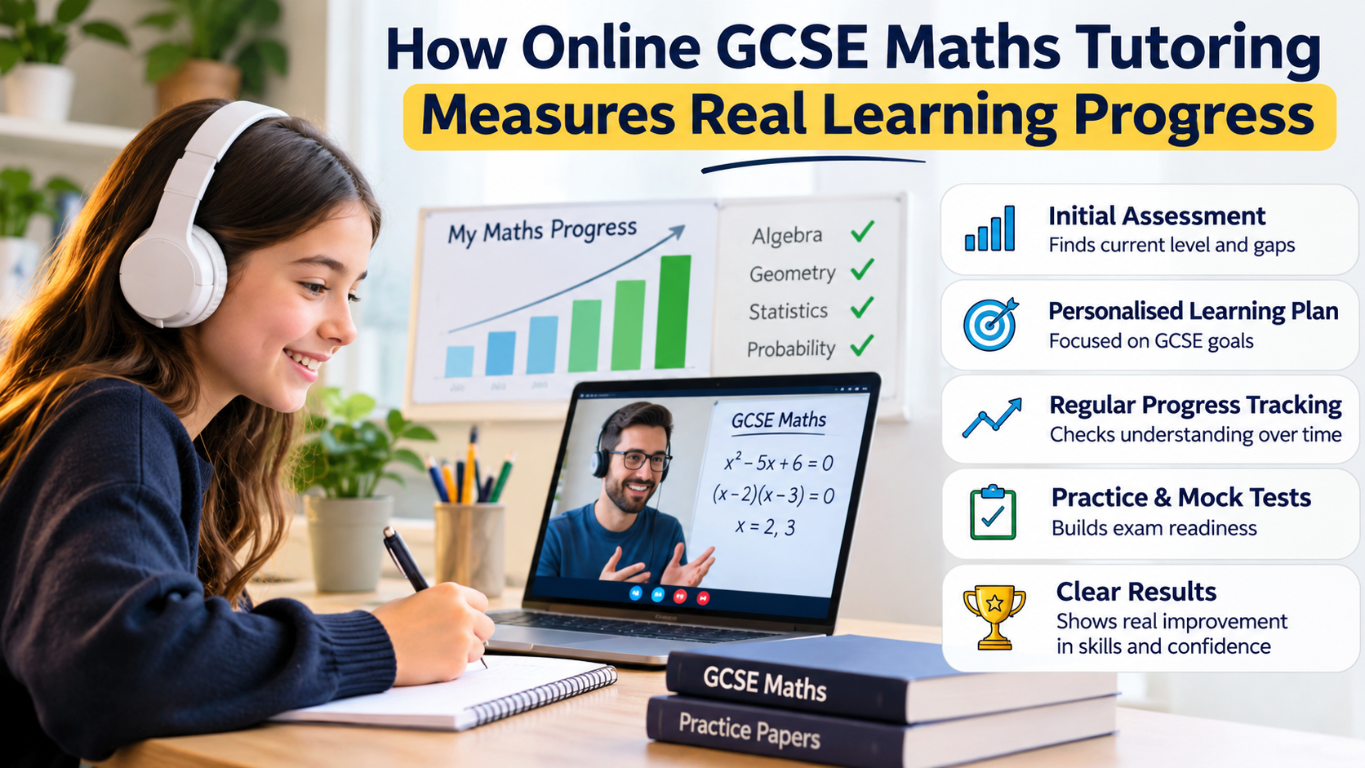
- Initial skill assessment: An introductory assessment can be used to determine what is known, what is familiar and what needs to be addressed. It also provides a basis for tutors to make comparisons between future performances.
- Topic-wise practice: Tutors can review the topics like algebra, fractions, geometry, statistics and probability rather than using the complete-length mock exams. This helps to pinpoint gaps in learning.
- Reviewing mistakes: A wrong answer may indicate that the student does not have a good understanding of a concept, that he/she used an incorrect formula, that he/she made a calculation mistake, or that he/she misinterpreted a question.
- Observing problem-solving methods: Tutors will be able to evaluate students' problem solving, organization of work, explanations, and answers for an incorrect solution.
Make Regular Feedback Measurable
It is best to give feedback when students know what they did right and what they need to work on. There is no explanation of how to improve when an answer is marked incorrect. Tutors need to guide students in identifying the cause of the mistake and then give them the opportunity to practice the correct way.
A student who often fails to solve quadratics successfully might benefit from more practice with factorising before tackling more difficult problems. After the underlying concept is understood, their accuracy and confidence can go hand in hand.
Online mathematics tutors can help with this process as follows:
- Customised practice questions which reflect current learning needs.
- Explanation and step by step solution of errors.
- Brief revision tasks to revise what has already been learnt.
- Easing the difficulty of the questions as understanding goes up.
- Positive comments acknowledging effort and improvement.
Help Parents Participate in the Learning Journey
Parents are an important part of helping a child to prepare for GCSEs. But measuring progress should not be limited to such things as homework marks or inquiries about examination grades.
Parental involvement in regular communication with tutors can enable parents to know what their child has learnt, what further practice is needed and if their child is studying well.
At SkillBridge Tutors, a systematic approach to online mathematics tutors can assist families to concentrate on practical criteria like:
- Work completion of practice work.
- Improvement in previously challenging topics.
- Self-explanatory mathematical concepts.
- Engagement and self-assurance in lessons.
- Consistency in revision and preparation.
Additionally, parents are able to meet with tutors to discuss realistic learning targets and check in regularly.
Make Every Learning Milestone Count
GCSE Maths preparation isn't about getting a specific grade. It is also the development of logical thinking, accuracy, confidence, and solving problems which are not familiar.
At SkillBridge Tutors, students are provided with customized academic guidance based on a student's learning needs. A structured way of doing maths, receiving feedback, and tracking progress makes preparation of mathematics easier and more manageable. The use of an online gcse maths tutor can help students to see their progress, identify any gaps in understanding and feel more confident when sitting exams.
Frequently Asked Questions
What to do next
- • Apply these tips in your next revision session and track progress weekly.
- • Focus on the subjects that feel hardest first, then build confidence with easier topics.
- • Book a free demo to get a personalised study plan from our expert tutors.